7/13/2005

On the Virtue of Silence:

“Jesus made no reply, not even to a single charge-to the great amazement of the governor.” Matt 27:14 NIV

“But Jesus still made no reply, and Pilate was amazed.” Mark 15:5 NIV

In the current difficult time in the Anglican Communion, the actions of the General Convention of ECUSA have been soundly criticized, and those who voted affirmatively on the consent to the election of Bishop Robinson have been accused of everything from immoral action to doing the work of the devil.

The response of the ECUSA team at the ACC Meeting and the document entitled “To Set Our Hope on Christ” were responsible and important efforts to engage the issues with honesty. The Archbishop of Canterbury has acknowledged the value of these presentations. But these efforts also met with an extraordinary hostile reception by others.

At some point we must decide that we have made our reply – that the words of those presenting at ACC were enough, or if not them, some wider set of responses – but at some point, enough.

At that point we might take our lead from Our Lord Jesus and stop speaking. His yes had been yes, and his no, no, and that is sufficient for the day. Jesus embarked on a silent vigil, not long lived, in which events and actions play out to their end. The spiritual said it best, “He never said a mumblin’ word.”

I was reminded of the power of such a vigil by a letter received this morning from a friend, Patricia Kerby Gibler, who leads a Silent Vigil here in Lewes, Delaware, where every Sunday from 1 to 1:45 PM we hold signs with names, pictures, and numbers of Americans who have died or were wounded in Iraq, and Iraqi civilians who have been killed. This vigil has been going on for ten months now and will continue while events and actions play out to their end both in Iraq and here in the U.S. There is another group, not silent but noisy and hostile, across the street. They make the silence difficult.

Here in part is what Patricia said in her note:

“Dear Friends from the Silent Vigil,

Last weekend, I had a conversation with a man about the guys across the street. It went something like: how can we have world peace if we aren't able to dialogue with the guys across the street. This could be a good purpose for some. It's not the purpose of the silent vigil, however. Our purpose is to stand, silent, for 45 minutes with our distractions, as much as possible, in a place that brings us to a bigger awareness, out of which can come all sorts of movements toward peace.

I suggest we look at the distractions from across the street and elsewhere as ways of increasing this awareness for the dead. The guys across the street stand in presence for the dead also, with an awareness which is kind of like a banked pool shot that hits the edge of the table and turns, perhaps, to drop into this place of compassion. As has been true for some of you, I try to let them be a tool for deeper silence. One woman said, every sound is a prayer.

So the distractions...the police and where they are and who they're talking to, our issues of freedom of speech and assembly and where we stand, the guys shouting across the street, and the honks for democracy, can be mirrors reflecting back an energy that can work to move us toward the end of the counting of the dead. This energy is very illusive and fragile but also reliable and trustworthy. It's a peace that does not come in a way that rips kids from the streets, and wastes their life.”


In the effort to be open to the work of the Holy Spirit in the Episcopal Church’s decisions so hotly contested these days, I wonder if our spiritual welfare might require that at some point that we know that we have said enough and, as regards the matter of defense, let the defense rest. From that point we might verbalize our concerns for the sufferings of the world, but keep silent vigil on the defense of ourselves against our fellow Anglicans.


At some point the constant hostility and criticism we face in the Anglican Communion controversies becomes, like the protests from across the street, a distraction from the realities of God’s suffering world. May we take those distractions and turn them to further spiritual grit, food for peace in our souls.

Further Remarks on the Gathering Swarm

Yesterday I posted on my blog an article titled, “The Gathering Swarm: The effort to capture the queen, or move the hive to warmer climes.” Last night I read an informative article on the Living Church online, http://www.livingchurch.org/publishertlc/viewarticle.asp?ID=1139 titled, “Nassau Meeting Concludes,” that essentially confirmed my sense that the effort is now underway to draw together a group from the Americas and from Africa in order to develop an alternative Communion.

Additionally, several persons on this list have drawn our attention to an upcoming conference in Pittsburgh, called “Hope and a Future” http://www.anglicanhope.org/index.php?section=1 This conference is sponsored by many of the organizations who were present at the Nassau conference. The conference web page carries this byline from the Moderator of the Network of Anglican Communion Dioceses and Parishes, “"Mobilizing and empowering everyone - especially the laity - is essential to the rebirth of a Biblical, missionary and united Anglicanism in North America. This is the vocation of the Anglican Communion Network and this is what the "Hope and a Future Conference is all about. As we move toward the challenges of 2006, I believe this conference will also be a key witness to the strength of our movement." This conference looks very much like an effort to solidify the North American effort so that with the "Global South" representation of the Province of the West Indies and the Southern Cone a legitimate anchor for the sort of plan alluded to in the Living Church article and the papers earlier "discovered" might be built. It is significant that the Moderator is a prime mover in this.


The Living Church for July 24, 2005, also carries an article “Kenyans Request Removal of Episcopalians from Lambeth 2008, which confirms my belief that part of the plan by those advocating realignment for the overall “resolution” of the disagreements in the Anglican Communion includes pushing the Archbishop of Canterbury to invite only ECUSA bishops who will conform to Lambeth Resolution 1.10 which is increasingly being called, “the Church’s normative teaching on Human Sexuality.” This article refers to Lambeth 1.10 as the normative teaching, and notes that it is the fourth of the four instruments of unity to do so. (My belief is that Lambeth 1.10 is no such thing. See http://anglicanfuture.blogspot.com/2005/07/lambeth-resolution-110-1998-is-no.html )


The hope has been expressed by the planners of the 2008 Lambeth Conference that no one issue will monopolize the Conference. I don’t see how that will be possible at this juncture, since it appears increasingly the case that either a sizable number of ECUSA bishops will not be invited or a sizable number of bishops from other Provinces will withdraw. The issue that will monopolize the Conference will be that of its charter – will it remain an invitational gathering with no authority to make normative decisions (its current status) or will it become a chartered gathering with some legislative authority (under a covenant)? The only way not to have the next Lambeth Conference by overwhelmed by the realignment agenda would be for the Archbishop of Canterbury to exercise absolute authority as the host to invite who he wills and to set the agenda in such a way that it is clearly and decisively a conference of equals gathered for mutual sharing of concerns and NOT an occasion for power plays. Those who don't like the guest list could simply stay away. Those not invited could get over it and be thankful they did not have the expense of travel to England.

He might also simply determine that the Lambeth Conference will not now serve as an instrument of unity, and decide not to have the conference at all. After all, if the guests are in a sint, why host a dinner after all?

7/11/2005

The Gathering Swarm: The effort to capture the queen, or move the hive to warmer climes.

The Press Release from something called “the Anglican Pan American Conference” (held in Nassaua, Bahamas July 8-9, released July 10, 2005, is another indication that the game is afoot. Except of course it is not game.

What is afoot is the makings of a coup, this time a coup whose target is not a church, but the structures through which Anglican Communion self-identity have been organized. There are several possibilities for how this structural takeover might be accomplished.

The primary ones are: (i) to convince the Archbishop of Canterbury to reflect the Primates’ direction for the Communion or (ii) to remove the Archbishop’s unofficial primacy in the Anglican Communion and pronounce a new primacy, official and constitutionally structured around a president Primate of a community of Primates representing a significant portion of the Anglican provinces of the now existing Anglican Communion.

In either case the first order of business is to make the Primates and their organization the core element of unity for a constitutionally structured global “Communion.” One of the problems with the acquiescence of the Anglican Consultative Council to the Primate’s request that the Canadians and Americans not have seat and voice at the recent meeting of the ACC is that it adds weight to the primacy of the Primates among the so called instruments of unity (the Archbishop of Canterbury, the Lambeth Conference, the Primates Meetings and the ACC). There has been a growing effort to make the Primates decisions more than advisory to the Archbishop of Canterbury and reflective of collegial concern.

At some point, perhaps soon, the Primates may indeed meet and challenge the leadership of the Archbishop of Canterbury, by either directing that the Americans and Canadian bishops (or some subset determined by a litmus test) not be invited to Lambeth 2008 or demanding that the Church of England disavow full communion status to its relationships with ECUSA or the Anglican Church of Canada.

Should the Archbishop continue to invite bishops against the wishes of the Primates, or continue in communion with ECUSA and the Anglican Church of Canada, at least some of the Primates will be prepared to make an ultimatum: either the ABC must forfeit leadership of the Primates Meetings or significant numbers of the Primates are ready to reorganize (realign) around elected leadership and proclaim a communion of Anglican Provinces independent of the Church of England and its list of churches with which it is in communion.

The press release from the Anglican Pan American Conference speaks of promoting “our traditional Anglican heritage in submission to the Primates and the Archbishop of Canterbury.” As has been pointed out by several leaders in the realignment community, the Archbishop of Canterbury has a choice. If he remains in the “orthodox” camp he remains the focus of unity. If he does not, there is no reason to assume that “submission” to him will in any way continue. The symbol of that office might remain, but real leadership will pass to others. It is the Primates that is the new emerging focus of power and unity.

The recent proposal from the ACC that the Primates be included ex-officio in the meetings of the ACC is another effort to give larger leadership to the Primates.

It is important to note that this marks the second recent regional meeting of Primates, Bishops and Organizational leadership. The anchor for realignment in the Americas is being constructed, just as the anchor for realignment in Africa has been constructed from meetings of African Primates and Bishops.

The concerns that have surfaced in the past several months that matters might well come to a head prior to Lambeth 2008 seem well founded. Interviews with Archbishops, found documents for potential organization of an alternative Anglican Communion structure, pronouncements by Moderator of the Network of Anglican Communion Dioceses and Parishes calling on various organizations to “shape up” and unite around a common realignment effort, all give added weight to the notion that the swarm is gathering.

A look at the list of Provinces, Dioceses, organizations and groups represented at the meeting in Nassau gives a sense of the scope of this effort to provide an anchor for the power grab from the Americas. But it is an odd collection of groups. The only two Provinces represented as provinces are the West Indies and the Southern Cone. There is no indication as to whether these Provinces are really represented, or whether their Primates are acting independently of any collective decision making in their own provinces. Otherwise the organizations listed are a variety of realignment organizations, churches not in communion with the Archbishop of Canterbury, independent foundations, and in one case – the Diocese of Recife – a Diocese whose bishop has been deposed.

The “Anglican Pan American Conference” claims to draw its participants from “Communion-committed Anglicans.” They may be communion-committed, but they are not committed to the Anglican Communion as currently constituted.

I believe we need to take seriously the possibility that a coup is on, the purpose of which is to either weaken the role of the Archbishop of Canterbury to a sort of parallel to the Queen vis a vis Parliament, where his statements become only those approved by the leadership of the Primates, or to develop an new and improved Anglican international structure around which the bees will swarm.

The Archbishop must either preempt the Primates by both affirming his right to invite who he wills to Lambeth and reaffirming the advisory character of the Primates Meetings, which meetings are also at his invitation. If not the center will be lost to the Primates who will organize themselves.

Similarly, ECUSA and the Anglican Church of Canada must not allow their involvement in any of the instruments of unity within the communion to be further eroded by recommendations that they “voluntarily” withdraw for decision making bodies. That the ACC could make recommend substantive changes in its constitution and exclude the Americans and Canadians from committees of the ACC without the voting presence of two of its members is outrageous. If the Primates were to meet without the invitation of both the American and Canadian Primate and make substantive decisions in the name of the whole Communion, I believe we would need to mount the most rigorous protest.

The end of the matter will be unsightly: There will either be an Archbishop of Canterbury inviting to his table only those guests approved of by others, an Archbishop breaking communion with several old friends, or should the Archbishop invite the Americans and Canadians, people removing themselves and setting table elsewhere and claiming to be the “real” Anglican Communion true to the spirit of Anglicanism.

Of course many of us will go to church on Sundays, give for the work and mission of the Church, and live assured of God’s grace in our lives. We will wonder what all the noise is about. We will be right to so wonder.

7/10/2005

On taking time


Our first grandchild is born...Lily Anne Harris. She and mother and father are all well. We grandparents are as proud as can be!

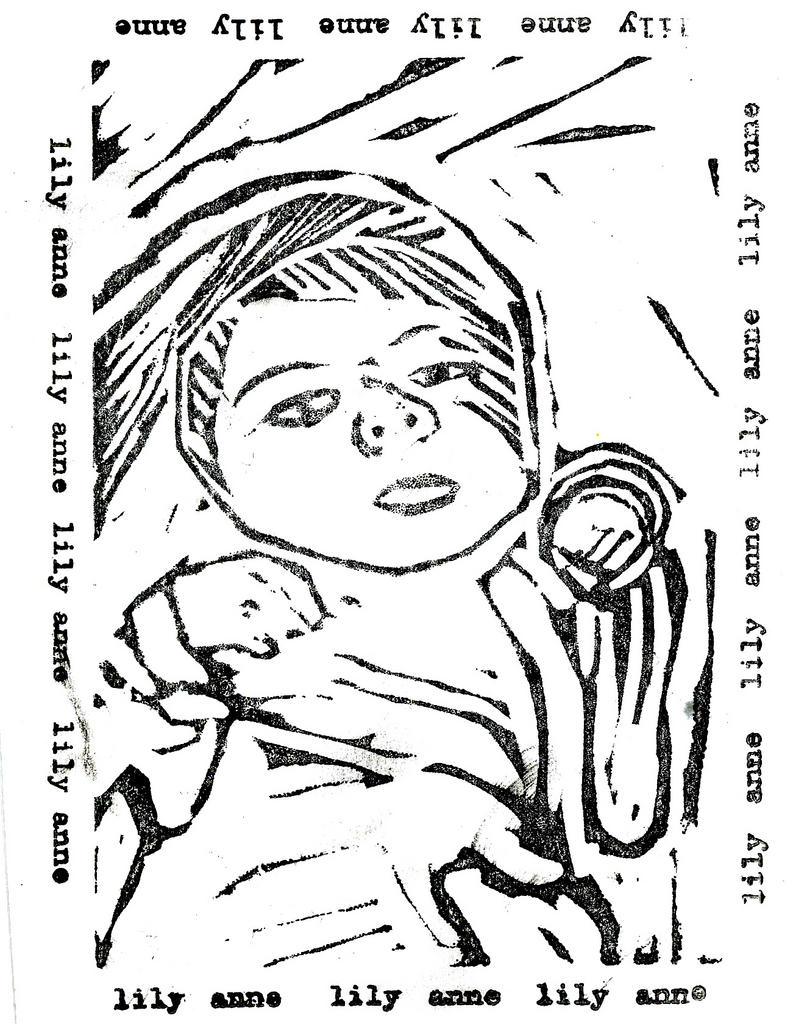
In remembrance and care for the moment I cut a printing block of her first picture, and type set the words around the edge. Here it is.

It got me to thinking: It took no time at all to take pictures of Lily Anne and broadcast them around, and it takes no time at all to send out this blog. But it took a great deal of time to carve the block, and real labor to set the type. That time and labor were a gift of love.

Suppose in all our mutterings about the Church we love we also had to take the time to set the type. Suppose our pictures and opinions were more difficult to produce, broadcast, make? Would we possibly exercise greater care in what we did? Would our words find refinement in the actual practice of setting the type? Perhaps part of our strange difficulties in these days is the fact that we can express our love with less need for care and attention to detail. If it were a harder task to get the words on the page, would we use them more sparingly and perhaps more gracefully or artistically?

I am grateful for the wonders of communication, but sometimes awed by its responsibility.

7/06/2005

Lambeth Resolution 1.10, 1998, is no "Official Teaching of the Anglican Communion"

There has appeared a document on Discipline of Clergy in the Church of England, written by Dr. James Behrens, Chancellor of the Diocese of Leicester and Bristol, which contends that homosexual activity among clergy of the C of E can lead to church discipline because, among other things, “It is contrary to Resolution 1.10 of the Lambeth Conference 1998, which is the official teaching of the Anglican Communion on the subject….”

A friend asked that this be challenged by “someone in authority.”

I have no authority beyond my words and their value, but such authority is sufficient, I suppose to remind us all that resolutions of the Lambeth Conference are not proposed as “the official teaching of the Anglican Communion.” At their best they represent the mind of the conference on particular issues. Most are carefully crafted NOT to presuppose such authority.

Dr. Behrens’ argument that Resolution 1.10 is the “official teaching of the Anglican Communion” will not stand up in the face of the overwhelming evidence of the way in which Lambeth Conference resolutions are generally treated, and in particular against the text itself.

I have listed the action verbs of each subsection of the resolution. At the end of this paper I provide the full text of the resolution.

--- This Conference: Commends, upholds and believes, recognizes, rejecting, calls on, cannot advise, requests, Notes ---

Nowhere in the text of the resolution is there any statement that what is written there is the “official teaching of the Anglican Communion.” Further, the language is clearly about “This Conference” and its findings.

The only action verb that comes close to being a “door closing” authoritive statement is the phrase in 1.10.d, while rejecting homosexual practice as incompatible with Scripture, calls on all our people to minister pastorally and sensitively to all irrespective of sexual orientation and to condemn irrational fear of homosexuals, violence within marriage and any trivialisation and commercialisation of sex” and even there it is a prelude to a positive action.

It is the Lambeth Conference, and specifically the 1998 Lambeth Conference, that rejected homosexual practice as incompatible with Scripture. There is no legislative or even moral basis on which to say that ANY resolution of ANY Lambeth Conference is “official teaching.” At best all resolutions express the “mind of the house.”

That does not mean that these resolutions can be taken lightly. Indeed I would hope that they are taken quite seriously, and would hope that the mostly forgotten report “Called to Full Humanity” that was the study document that was produced for the section of the Conference dealing with, among other things, homosexuality, would still find its place in the thoughtful writings contributing to Anglican Communion self-understanding. It was unfortunately swallowed whole and digested incompletely.

No doubt the resolutions of Lambeth Conferences carry weight in arguments that chancellors find themselves addressing, and perhaps Dr. Behrens can find some other way of making use of Resolution 1.10 in his argument. But it is fallacious to claim that Resolution 1.10, or any resolution carries weight as “the official teaching of the Anglican Communion.”

What is most disturbing is that when chancellors and others begin talking about the evidence of a teaching, and finding it in Lambeth Conference resolutions they are giving to the Conference a legal status as a legislative body, which it clearly does not have. But if they can talk that way long enough and if there is little enough objection, such opinions become more solidly ensconced and seemingly “self-evident.”

It may be that in some future Anglican configuration, with “instruments of unity” that do carry legislative weight, it will be possible to say of a meeting of Bishops that they determined the official teaching of the Anglican Communion. But “bishops only” is less and less viable as a way of doing the teaching of the church.

Given the proposition that all Primates be made members of the Anglican Consultative Council we will be making that body more and more episcopal in makeup, and it too might become a way of determining “official teaching,” if by official teaching we mean the teaching of bishops.

But now is now, and then is then. Now there is no such “official teaching,” and then I doubt many of us will be part of that Anglican configuration anyway.

The inadequacy of the proposition that Resolution 1.10 is the official teaching of the Anglican Communion is shown by refusing to teach it. What will be done then? On what basis could ecclesiastical charges be brought?

None of this would matter except to note that folk like those in Anglican Mainstream have been quick to publish Dr. Behrens’ statement as a way to affirm their notion that there is an official teaching on the matter of homosexual relationships.

No question that there are many who don’t believe that homosexual practice is compatible with Scripture. But an official teaching of the Anglican Communion, it is not.

For your interest, here is the actual text of Lambeth Resolution 1.10

The full text is as follows:

Resolution I.10

Human Sexuality

This Conference:

(a)

commends to the Church the subsection report on human sexuality;

(b)

in view of the teaching of Scripture, upholds faithfulness in marriage between a man and a woman in lifelong union, and believes that abstinence is right for those who are not called to marriage;

(c)

recognises that there are among us persons who experience themselves as having a homosexual orientation. Many of these are members of the Church and are seeking the pastoral care, moral direction of the Church, and God's transforming power for the living of their lives and the ordering of relationships. We commit ourselves to listen to the experience of homosexual persons and we wish to assure them that they are loved by God and that all baptised, believing and faithful persons, regardless of sexual orientation, are full members of the Body of Christ;

(d)

while rejecting homosexual practice as incompatible with Scripture, calls on all our people to minister pastorally and sensitively to all irrespective of sexual orientation and to condemn irrational fear of homosexuals, violence within marriage and any trivialisation and commercialisation of sex;

(e)

cannot advise the legitimising or blessing of same sex unions nor ordaining those involved in same gender unions;

(f)

requests the Primates and the ACC to establish a means of monitoring the work done on the subject of human sexuality in the Communion and to share statements and resources among us;

(g)

notes the significance of the Kuala Lumpur Statement on Human Sexuality and the concerns expressed in resolutions IV.26, V.1, V.10, V.23 and V.35 on the authority of Scripture in matters of marriage and sexuality and asks the Primates and the ACC to include them in their monitoring process.