It is hard to know which is more shameful: (i) That the Government of Nigeria proposes to make unlawful homosexual behavior and freedom of speech and assembly for homosexuals; or (ii) that there is support of such proposed laws by the Church of Nigeria (Anglican).
Fr. Jake of “Fr. Jake Shakes the World” does a splendid job of spelling out the real scandal of the Church of Nigeria’s support for these repressive measures. He states at the close of his essay, “The actions of the Church of Nigeria in this one particular story alone would seem sufficient to give anyone, conservative, liberal or moderate, reason to seriously reconsider if this is the direction the Anglican Communion wants to move in the future.”
Several writers, along with Fr. Jake, have pointed out that the Church of Nigeria’s support of the State’s proposed repression of homosexual freedoms of assembly and speech is so far from the statement of the Lambeth Resolution 1.10 as to constitute a betrayal of the intentions of that Resolution. That statement read in part, “We commit ourselves to listen to the experience of homosexual persons and we wish to assure them that they are loved by God and that all baptised, believing and faithful persons, regardless of sexual orientation, are full members of the Body of Christ...”
Voice of America online reports on the comments of the Anglican Church in Nigeria’s spokesman:
“The Anglican Church in Nigeria Thursday said it welcomes government decision to push for legislation to outlaw homosexuality. The government said it will introduce legislation to punish homosexuality by up to five years in jail and ban same-sex marriages. A spokesman for Nigeria's Anglican Church described homosexuality as an abomination.
The spokesman for the Anglican church in Nigeria, Reverend Tunde Popoola, says the proposed ban is appropriate. The Anglican community in Nigeria has long waged a vigorous campaign against homosexuals, as Reverend Popoola explains.
"The Anglican church in Nigeria has been in the forefront of condemning the attitude because the church sees it as an aberration, in other words, we see it as against the norm. We see it as an abomination," he said.”
It is not hard to understand the Church of Nigeria’s support. The political and social pressures in Nigerian society must be immense, split as it is by serious religious and social divisions. But in speaking out in favor of the proposals and by not distancing themselves from the repression the proposals will bring the Church of Nigeria succumbs to very charges it raises against the West, namely that of becoming subservient to the culture.
It is doubly disappointing that the Church of Nigeria has not spoken out against these proposals, since the Church has exercised some courage in denouncing corruption in Government. If the Church felt it could not speak out forcefully (which is what is needed) at least it could have called for further conversation and discussion, or something!
The fact is that the Church of Nigeria, and in particular the Archbishop, Peter Akinola, are indeed supportive of laws which will criminalize homosexual behavior and any assembly or speech in support of homosexual persons.
Stephen Bates, in A CHURCH AT WAR, asks, “Why has no one told Peter Akinola that he is a bigot?” (pg 306, new edition) So let us ask that. What is left of the Archbishop’s claim to moral virtue when he supports the suppression of any and all expression from homosexual persons? What is left of the claim that he assures homosexual persons that “they are loved by God …and full members of the Body of Christ.”?
And, while we are at it, shame on the American Anglican Council that can cause a critical comment on the persons nominated for Presiding Bishop to be written in less than eight hours from the time of the announcement of the slate, and yet does not seem to be able to criticize the support of the Church of Nigeria for the criminalization of homosexuals in Nigeria.
We might also note that the Moderator of the Network of Anglican Communion Dioceses and Parishes, seemingly a good friend of the Archbishop of Nigeria, likewise seems to have nothing to say about the bigotry inherent in the Church of Nigeria’s support.
And why the silence from the Archbishop of Canterbury and the Episcopal Church?
What is going on here? Is it simply that everyone in the Anglican World is so embarrassed by the position of the Church of Nigeria that they are stunned to silence? Is it that no one wants to put the Church of Nigeria on the spot because relations with the State are tenuous? Perhaps the Church of Nigeria is unwilling to speak because everyone is jumping aboard the bandwagon to criminalize homosexuals in Nigeria.
Perhaps too no one really takes seriously the extent to which the planned limits placed by Nigeria on freedom of speech, freedom of assembly and freedom of association run counter to the most basic of human rights and counter to the best hopes of life in religious community. But surely some people in authority in the church somewhere can speak out!
The critiques that exist so far come from various blog sites. That is not enough.
There has been an important and powerful (and short) essay in the Church Times condemning the proposed laws and asking the Church to speak up. That is a good start. There must be more. If the Church of Nigeria is unwilling to speak out, others must.
I call on the Archbishop of Nigeria to speak out against the repressive laws being proposed by the Government of Nigeria. If he cannot or will not do so, I call on the AAC and the Network to distance themselves from his support of this repression.
I call on the Archbishop of Canterbury and the Episcopal Church to issue statements critical of the repressive laws being proposed by Nigeria.
As Giles Fraser, author of the Church Times essay, “Would You Walk From A Lynching” says, “Forget the unity of the Church: not standing up to this is tantamount to walking away from a lynching.”


1/13/2006
Campaign Stirrings and a New Offensive Stragegy.
After a very short lull at Christmas the realignment crowd is back in action. I hope their Christmas was peaceful. Mine was.
I had hoped that the Incarnational truce might extend into the New Year, but no such luck. In the past twelve days there have been various stirrings:
It began with the ordination at the Network conference in
At the time of the ordinations it was pointed out that the ordinations in
In the new year the Archbishop of Uganda wrote a scathing letter to The Rt. Rev. Peter Lee, Bishop of Virginia concerning Bishop Lee’s determination that The Rev. J. Phillip Ashley was no longer in the ordained ministry of the Episcopal Church. Again, there was a flurry of interest, but then it subsided.
The tone of Archbishop Orombi’s letter was at the very least belligerent. He accused Bishop Lee of misunderstanding the plain English of Mr. Ashley’s letter of resignation just as by implication Bishop Lee and others are involved in “reinventing the plain meaning of Scripture.” He ended his letter by informing Bishop Lee that “We pray for your repentance and the repentance of all the ECUSA leadership, and for your return to the historic faith and communion of the one, holy, catholic and apostolic church.” Not exactly a friendly bit of interchange!
Archbishop Orombi in his letter to Bishop Lee confused three distinct issues: (i) the indelible character of ordination, (ii) matters of Church discipline in which those ordained are licensed, enrolled as part of the clergy of the Church and practice by oaths of obedience and canons of the church and may not unilaterally end their canonical relationship with the Bishop who has charge over them, and (iii) the principle, ancient in origins and recently affirmed in the Windsor Report and other documents, that within diocesan boundaries it is the bishop of that location that holds the right to issue permission to act in a ministerial capacity.
Archbisho Orombi was right about only the first of these three, and used the truth of that statement to essentially disregard the oaths of obedience Mr. Ashley took at his ordination or the ancient agreement of the Church concerning area authority of bishops. Well, it will all come home. One day Mr. Ashley will decide that Archbishop Orombi or the bishop of Rwenzori Diocese has no hold on him either. How can one trust a person in larger things who cannot keep his word on lesser things?
Mr. Ashley cannot unilaterally determine that he is free from the canonical authority of the Bishop. I have not always been comfortable to be a priest under such a commitment to obedience, but at least I acknowledge the reality of the oath.
Bishop Lee and the Standing Committee of Virginia did Mr. Ashley a service in determining that Mr. Ashley has renounced the ministry of the Episcopal Church. At least then the real issue is clear: Mr. Ashley is not licensed to minister in the Episcopal Church, no matter the validity of his orders. He is operating under license of the Bishop of Rwenzori in the Church of the
This small church fight is an example of the total disregard by the realignment leadership of the boundaries of ecclesiastical authority. It is one of a continuing salvo of fire against the authority of bishops with whom they disagree.
There are now a number of Provincial Archbishops and several bishops that have declared that their churches are out of communion with the Episcopal Church and that they are therefore not bound by the normal boundary rules. Morgan’s article in Christianity Today lists the following:
That same article makes it clear that the Bishop of
Morgan’s article is a must read. In particular his description of a realigment global strategy is important to understand.
If Morgan is right, the strategy that is now in place puts off the real place of hostile takeover to the Lambeth Conference of 2008. He quotes Stephen Noll as saying, “the Episcopal Church, as it is now constituted, is unreformable.” That being the case, the strategy outlined by Morgan is important for it points directly to Lambeth and does not mention General Convention at all.
But one piece of the strategy is not mentioned, but I believe is certainly assumed: I believe there will be a challenge mounted against the presence of Episcopal Church bishops and an insistence that Lambeth include only those who will renounce the actions of the Episcopal Church. The alliances being made between several Episcopal Church bishops, bishops from several Provinces of the Anglican Communion and a variety of continuing church leaders and members of the Reformed Episcopal Church are all pointing to the same hostile takeover previously written about in terms of a coup by a wide variety of authors on the internet and by Stephen Bates in his book, A Church at War.
What is perhaps of most importance at the moment is that if Mr. Morgan is correct the real place where all this will get settled is not at General Convention this year but at Lambeth in 2008. According to Morgan, at that time demands will be made for a covenant statement that Scripture is supreme “over all church teachings, leaders and institutions.” Morgan speaks of this as an Anglican “covenant.”
This should not be confused with the Anglican Covenant proposed in the
That slogan was used by Archbishop Orombi in his letter to Bishop Lee when he said that ECUSA was “reinventing the plain meaning of Scripture.” In an interestingly scary way the Bishop of Pittsburgh is quoted by Morgan as saying, “it’s (the Anglican church) also worldwide probably the best positioned to say – “No!” – when the culture gets away from the plain revelation of God.”
It is a short step from the “plain meaning of Scripture” to the “plain revelation of God.” The first seems more or less reasonable – proposing that Scripture means what it says - OK, with perhaps some quibble about the offenses for which execution is the required remedy and the details of the creation story and perhaps the massive problem that the New Covenant is not congruent with the Old Covenant. But the second, “the plain revelation of God,” takes us down the path that places the supremacy of Scripture outside the interpretative environment of the Church, with all its quirks, and in the hands of those to whom it has been particularly revealed by God. And just who might those persons be?
This is why the salvos of these past days are of importance. The various incursions into the Episcopal Church have assumed broken communion. They assume to that the Episcopal Church is “unreformable.” Things are moving to a showdown, most likely at Lambeth where a Trojan Horse covenant on Scripture will be presented and then overwhelmed by the claim of “the plain revelation of God.” The end of all this will be a mess of revelation pottage. Having thrown out us revisionists – so-called – they will begin throwing out one another on the basis of the charisma of knowing the “plain revelation of God.” Good luck! And their last state will be worse than their first.
It seems to me the way forward for progressive folk in the Episcopal Church is to continue being part of the Episcopal Church, learning as we go to accept criticism, love the critics, and do a lot of listening. We ought to assume we have an obligation to be part of the Anglican Communion and its instruments of unity. We may or may not be part of the Anglican Communion if it gets redefined by the realignment folk, we may or may not be in communion with the Bishop of Bolivia or the Archbishop of Uganda. But it will all work out alright in the end. God, the great net fisher, will sort it all out. Meanwhile there are people to feed, love, challenge and engage.
1/10/2006
On the Matter of an Authentic Christianity:
In response to a sentence in my posting, “A Church at War,” one person wrote, “What objective standard would you use to determine the existence of a ‘more authentic Christianity?’”
The sentence in question was, “It is glaringly obvious, from reading Bates’ fine book on a Church at War that whatever our hopes for a more authentic Christianity, particularly one that sees God at work in culture as well as over against culture, those hopes do not lie with the realignment movement or with the English hard line evangelicals.”
Good question.
Let me first say that my comment was about Bates’ devastating journalistic account of the political manipulations of the players in the American realignment and English reform groups. Given his account, I came to the conclusion that whatever counts as an authentic Christianity will be found somewhere else. The reader was quite right to point out that I don’t define what would count as an authentic Christianity or how one might go about providing an objective standard for determining that something was an expression of authentic Christianity. Implicit in his question is whether I am just muttering slightly warm air or have any sense of what I was talking about. Good question indeed.
So here is a small beginning stab at a personal faith statement of what I consider authentic Christianity to be and how one might go about testing if one’s own expression of faith meets the test. It is of course a futile small and unworthy effort if for no other reason than that words fall short of adoration and ideas far short of grasping the joyful proposition that God is a present tense reality rather than a distant thunderer and / or a former creator now relaxing as the whole thing unwinds.
I am a Christian, among other reasons, because of the following:
(i) I have accepted Jesus' invitation, “follow me” and am working out the details. The best hints I have of what that means are that:
I am to practice, as he did, self-emptying - getting my ego out of the way of God’s spirit taking me where I would not otherwise go, to people and places beyond my imagining;
I will more and more caught up in the immediate follower’s experience of Jesus being the person in whom all the fullness of God is pleased to dwell, or alternately of Jesus as being the exact imprint of God in the world.
(ii) I take seriously William Stringfellow’s witness, that “I spend most of my life now with the Bible, reading or, more precisely listening.” (p. 3, Instead of Death) I am by no means as disciplined or as good at that as Stringfellow, but I am on my way. That listening itself is a practice, one which by no means is limited to the biblical material, but rather is without limits as we grow in our ability to hear the sufferings and joys of others and hear them without feeling threatened and without condemning - that is to hear them with compassion.
(iii) I practice being a companion and seeking companions on the way, trying not to be too ego centered and picky about those I break bread with. We say, the bread we eat is companionship too with the One we follow and that Jesus is thereby know to be with us on the way. We share all sorts of concerns and joys and sorrows, for the way stretches out before us as a way through the wilderness, and at the core of that sharing is the biblical witness. The bread is all the more tasty for being a meal on the journey.
So, my sense is an authentic Christianity consists of following Jesus without too much ego and in awe of knowing God present in him, in living in a mode of biblical listening, and in sharing the simplest of meals on the Way. An authentic Christianity, in this sense, is filled with the desire to practice self-emptying, to listen compassionately, and to share the bread of tomorrow.
What sort of “objective standard” might there be? Beats me. I suspect there is no objective standard. Yet anyone who is without guile (or ego demands), who listens and who walks in the way will have a sense of knowing the presence of someone practicing such a Christianity.
You may note that none of this has very much to do with Church in its complexities of historical functions, forms and theologies. I have sometimes said half jokingly that I don’t think Jesus had the Church in mind. It is indeed only half a joke. WE have the Church in mind as a way of responding to the notion of the people of faith as the Body of Christ. It is no joke to try to do this: to incorporate organizationally to be a collective reflection of authentic Christ presence, or an authentic Christianity. But I do think Jesus would be appalled by our behavior sometimes.
I love the Church in its efforts to be an embodiment of Christ in the world, and more particularly the Anglican Communion and the Episcopal Church as expressions of that effort. But I don’t for a moment confuse its standards for the demands of authentic Christian living. It does often provide better guidelines and signposts than we might otherwise be able to find, but it is finally to be judged by the least of the followers of Jesus Christ and its leaders brought to task for setting burdens on faithful people that are unnecessary or worse that separate us from the love of God known in others.
I am aware that after 40 years in the ordained ministry and 65 years of stumbling around on the planet this is hardly a well organized statement of what I believe it means to be authentically a Christian. The reader will easily recognize my shortcomings in not being able to provide any sort of “objective standard” for what it means to be an authentic Christian. Still, my sense is that we are likely to recognize such a Christian when we meet her. I know I have.
1/07/2006
"A Church At War"... required reading
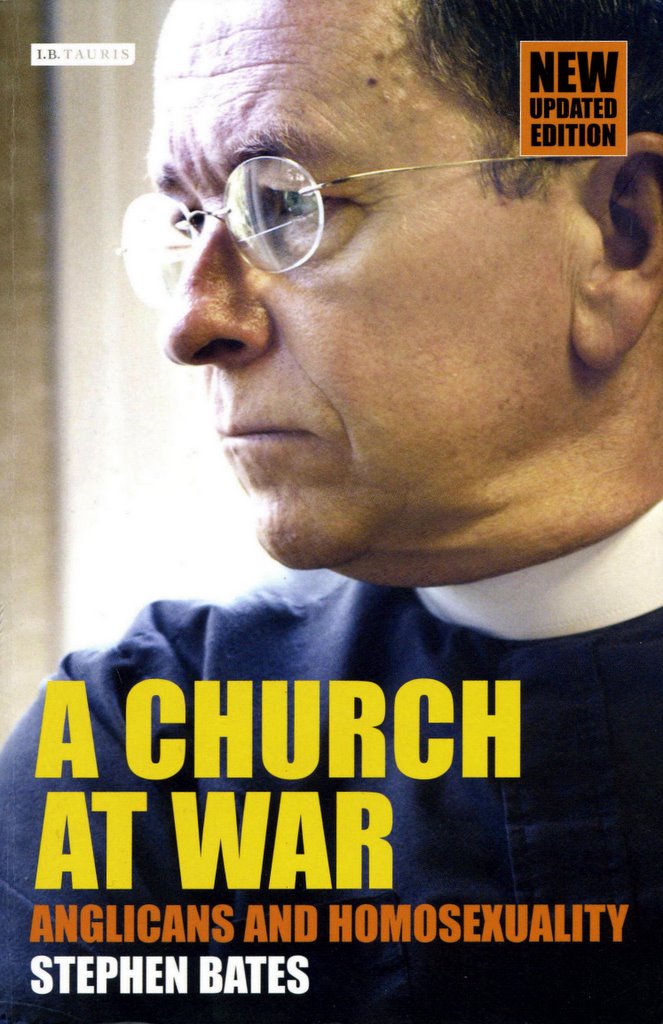
“A CHURCH AT WAR: Anglicans and Homosexuality” by Stephen Bates is a must read for anyone interested in digging deeper into the events and thoughts that lie behind the struggles for control of the future of the Church of England and the Anglican Communion. Released first in 2004, it was an immediate success. A paperback version was published in 2005 with updates. I have just finished reading the revised version and all I can say is, “buy this book and read it.”
Bates’ book reminds us that the increasingly harsh exchanges between those who see the acceptance of homosexuals in the Church as wrong and those who see it as a matter of justice are heavily influenced by attitudes unresolved in England for many years. From one perspective, the whole of the current controversy is part of the unfinished business left over from the Elizabethan settlement.
One of the fascinating features of this book is that is written by a journalist, not a theologian, and yet in his professional reporter’s attention to detail Stephen Bates never forgets that the facts reflect, for better or worse, a theological state of affairs. As a result a good bit of moral and theological observation arises from the reporting, and the principle threads of the book carry forward theological matters. As a history of the English evangelical struggle to take over the Church of England this book has no parallel in the Episcopal Church. Still, the concerns about the development of a coup raised by Fr. Jake Stops the World, several writers on the House of Bishops / House of Deputies list and my own essays here and in the Witness do constitute a parallel body of observations. The English evangelicals and the American realignment party are both struggling to take control of the future of these churches in what may be a last ditch effort to disavow the impact of modernity and post modernity.
Some years ago Bishop John A.T. Robinson suggested that a New Reformation might well be underway, or at least in order, one that would finally let go the encumbrances of this strange and dangerous thing called Christendom and instead have a more authentic community of the followers of Jesus the anointed one. It was hard to understand just what such a Christianity would look like – Robinson was somewhat acerbic and academic. Still, Robinson was calling us beyond the profoundly irrelevant posturing that is too much a part of the current power struggles that we see in some of the churches of the Anglican Communion.
It is unclear if Robinson’s hope for a Christianity working beyond modernity’s Christendom will emerge. It is glaringly obvious, from reading Bates’ fine book on a Church at War that whatever our hopes for a more authentic Christianity, particularly one that sees God at work in culture as well as over against culture, those hopes do not lie with the realignment movement or with the English hard line evangelicals.
12/24/2005
Christmas Eve, 2005 and The Exact imprint of God's very being.
It is, once again, a moment (as are all moments) in which we find God’s Grace abundantly present, if only we will look. The Feast of the Incarnation is the primary icon of attentiveness. Here we attend to small and large events, tenderness among a small group of persons and attention to angles voices. Tonight I attended to small things, close friends, good food, grateful hearts. It was enough.
This blog concerns a future for Anglicanism. So often what I post reflects an attention to various details of this or that action within the Communion and what they might mean for our future. It is very easy to become attentive to the details of our failures to be in communion. It is easy to be filled with despair for life together.
So on this Christmas eve, I want to write for a moment about God’s Grace present in our mostly common life as Anglicans.
All over the world tonight we Anglicans, along with many others, will sing songs about the wonder of the Incarnation, songs that will show how it is that Jesus is the exact imprint of God’s very being, (to quote Hebrews). It turns out that nothing matters as much as our attention to this reality, a reality only know in our willingness to accept Jesus into our presence (our hearts as the evangelicals would say). So we do.
Anglicans may not be uniformly good about rigorously separating the wheat from the chaff, feeling that such a task is best left until the end and a better judge, but we are very good at attending to the presence of Jesus. We are an incarnational family, knowing that the death on the cross comes to One who also is born of a woman. We are incarnational, knowing that God comes to us now, and every now, in form we can hold and touch, taste and see, and finally is not hidden from us. We believe breaking bread together is as good as it gets.
With all the difficulties of this past year for we Anglicans, perhaps it is in order to say that at the core all is well: Jesus Christ is present with us, we are cared for by One who is the exact imprint of God’s very being, the one present will be our judge, and even there the love of Jesus intervenes for us.
The matter of church “ness” will get straightened out, or not. There will be one Anglican Communion or none and it will always matter less than that God’s love is know to us in Jesus Christ.
I am not worried in the least: my soul, my self, my eternal present, is buried in Christ’s death and raised with His resurrection. The incarnation is the fact known by all believers that Jesus is present and his love is the exact love of God for us. It is true for me, true for you, true for my enemies and your friends, and vice versa.
At Christmas it is enough to know this. We will argue again later about who has this business of church right, but in the brokenness of Christendom I am more and more of a mind to say that none of us has it right and that that is not so very important.
We will argue again about whether or not gay and lesbian persons are wholesome examples for the faithful, but I am of a mind to say that for the faithful examples are not needed, rather companions are needed. And to that end let me say I have never been refused bread by a gay person (although surely some will do so) nor has a gay person crossed the street to avoid me (although that could change). And if they will walk with me and share bread with me, shall I not as well do so with them? And if the two of us walk, will Jesus not also come among us and break bread with us?
Maybe this year to come we can set our eyes and hearts higher: if we focus on the One in whom all the fullness of God was pleased to dwell, perhaps we will dwell together in peace as well.
Blessings on us all.
Subscribe to:
Posts (Atom)