7/10/2005

On taking time


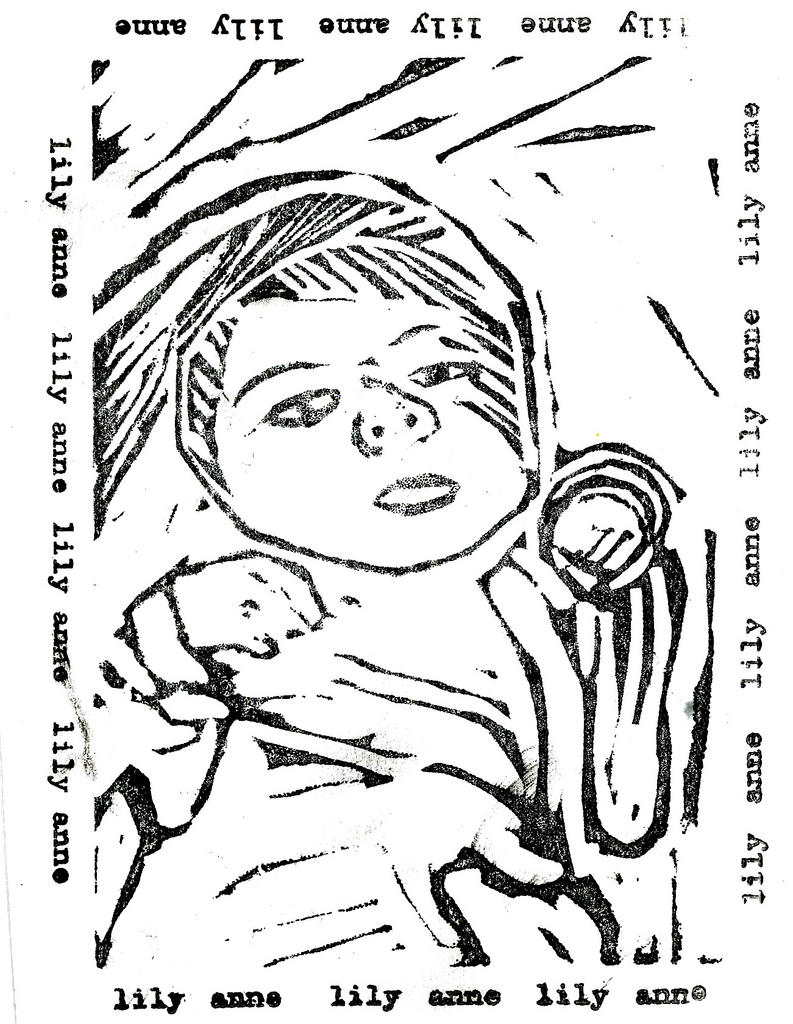
Our first grandchild is born...Lily Anne Harris. She and mother and father are all well. We grandparents are as proud as can be!

In remembrance and care for the moment I cut a printing block of her first picture, and type set the words around the edge. Here it is.

It got me to thinking: It took no time at all to take pictures of Lily Anne and broadcast them around, and it takes no time at all to send out this blog. But it took a great deal of time to carve the block, and real labor to set the type. That time and labor were a gift of love.

Suppose in all our mutterings about the Church we love we also had to take the time to set the type. Suppose our pictures and opinions were more difficult to produce, broadcast, make? Would we possibly exercise greater care in what we did? Would our words find refinement in the actual practice of setting the type? Perhaps part of our strange difficulties in these days is the fact that we can express our love with less need for care and attention to detail. If it were a harder task to get the words on the page, would we use them more sparingly and perhaps more gracefully or artistically?

I am grateful for the wonders of communication, but sometimes awed by its responsibility.

7/06/2005

Lambeth Resolution 1.10, 1998, is no "Official Teaching of the Anglican Communion"

There has appeared a document on Discipline of Clergy in the Church of England, written by Dr. James Behrens, Chancellor of the Diocese of Leicester and Bristol, which contends that homosexual activity among clergy of the C of E can lead to church discipline because, among other things, “It is contrary to Resolution 1.10 of the Lambeth Conference 1998, which is the official teaching of the Anglican Communion on the subject….”

A friend asked that this be challenged by “someone in authority.”

I have no authority beyond my words and their value, but such authority is sufficient, I suppose to remind us all that resolutions of the Lambeth Conference are not proposed as “the official teaching of the Anglican Communion.” At their best they represent the mind of the conference on particular issues. Most are carefully crafted NOT to presuppose such authority.

Dr. Behrens’ argument that Resolution 1.10 is the “official teaching of the Anglican Communion” will not stand up in the face of the overwhelming evidence of the way in which Lambeth Conference resolutions are generally treated, and in particular against the text itself.

I have listed the action verbs of each subsection of the resolution. At the end of this paper I provide the full text of the resolution.

--- This Conference: Commends, upholds and believes, recognizes, rejecting, calls on, cannot advise, requests, Notes ---

Nowhere in the text of the resolution is there any statement that what is written there is the “official teaching of the Anglican Communion.” Further, the language is clearly about “This Conference” and its findings.

The only action verb that comes close to being a “door closing” authoritive statement is the phrase in 1.10.d, “while rejecting homosexual practice as incompatible with Scripture, calls on all our people to minister pastorally and sensitively to all irrespective of sexual orientation and to condemn irrational fear of homosexuals, violence within marriage and any trivialisation and commercialisation of sex” and even there it is a prelude to a positive action.

It is the Lambeth Conference, and specifically the 1998 Lambeth Conference, that rejected homosexual practice as incompatible with Scripture. There is no legislative or even moral basis on which to say that ANY resolution of ANY Lambeth Conference is “official teaching.” At best all resolutions express the “mind of the house.”

That does not mean that these resolutions can be taken lightly. Indeed I would hope that they are taken quite seriously, and would hope that the mostly forgotten report “Called to Full Humanity” that was the study document that was produced for the section of the Conference dealing with, among other things, homosexuality, would still find its place in the thoughtful writings contributing to Anglican Communion self-understanding. It was unfortunately swallowed whole and digested incompletely.

No doubt the resolutions of Lambeth Conferences carry weight in arguments that chancellors find themselves addressing, and perhaps Dr. Behrens can find some other way of making use of Resolution 1.10 in his argument. But it is fallacious to claim that Resolution 1.10, or any resolution carries weight as “the official teaching of the Anglican Communion.”

What is most disturbing is that when chancellors and others begin talking about the evidence of a teaching, and finding it in Lambeth Conference resolutions they are giving to the Conference a legal status as a legislative body, which it clearly does not have. But if they can talk that way long enough and if there is little enough objection, such opinions become more solidly ensconced and seemingly “self-evident.”

It may be that in some future Anglican configuration, with “instruments of unity” that do carry legislative weight, it will be possible to say of a meeting of Bishops that they determined the official teaching of the Anglican Communion. But “bishops only” is less and less viable as a way of doing the teaching of the church.

Given the proposition that all Primates be made members of the Anglican Consultative Council we will be making that body more and more episcopal in makeup, and it too might become a way of determining “official teaching,” if by official teaching we mean the teaching of bishops.

But now is now, and then is then. Now there is no such “official teaching,” and then I doubt many of us will be part of that Anglican configuration anyway.

The inadequacy of the proposition that Resolution 1.10 is the official teaching of the Anglican Communion is shown by refusing to teach it. What will be done then? On what basis could ecclesiastical charges be brought?

None of this would matter except to note that folk like those in Anglican Mainstream have been quick to publish Dr. Behrens’ statement as a way to affirm their notion that there is an official teaching on the matter of homosexual relationships.

No question that there are many who don’t believe that homosexual practice is compatible with Scripture. But an official teaching of the Anglican Communion, it is not.

For your interest, here is the actual text of Lambeth Resolution 1.10

The full text is as follows:

Resolution I.10

Human Sexuality

This Conference:

(a)

commends to the Church the subsection report on human sexuality;

(b)

in view of the teaching of Scripture, upholds faithfulness in marriage between a man and a woman in lifelong union, and believes that abstinence is right for those who are not called to marriage;

(c)

recognises that there are among us persons who experience themselves as having a homosexual orientation. Many of these are members of the Church and are seeking the pastoral care, moral direction of the Church, and God's transforming power for the living of their lives and the ordering of relationships. We commit ourselves to listen to the experience of homosexual persons and we wish to assure them that they are loved by God and that all baptised, believing and faithful persons, regardless of sexual orientation, are full members of the Body of Christ;

(d)

while rejecting homosexual practice as incompatible with Scripture, calls on all our people to minister pastorally and sensitively to all irrespective of sexual orientation and to condemn irrational fear of homosexuals, violence within marriage and any trivialisation and commercialisation of sex;

(e)

cannot advise the legitimising or blessing of same sex unions nor ordaining those involved in same gender unions;

(f)

requests the Primates and the ACC to establish a means of monitoring the work done on the subject of human sexuality in the Communion and to share statements and resources among us;

(g)

notes the significance of the Kuala Lumpur Statement on Human Sexuality and the concerns expressed in resolutions IV.26, V.1, V.10, V.23 and V.35 on the authority of Scripture in matters of marriage and sexuality and asks the Primates and the ACC to include them in their monitoring process.

7/04/2005

Sermon: No Heavy Burden.

Sermon for 7 Pentecost:

The Gospel read this morning can be viewed as a little drama in three parts: Jesus first prays to God, “I thank you Father…” He then, as a rabbi, comments on this prayer in a teaching for his disciples and perhaps some others close at hand. And at the last he addresses the crowd. We can even think about how we would stage this: The movement is from prayer, to teaching, to proclamation. So the gaze of Jesus might be up to heaven, then down and near to his friends and disciples, and then out across the heads of the people yearning to hear.

The last section is this wonderful and freeing statement: “Come to me, all you that are weary and are carrying heavy burdens and I will give you rest. Take my yoke upon you, and learn from me; for I am gentle and humble in heart, and you will find rest for your souls. For my yoke is easy, and my burden is light.”

Many of you will recognize this phrase. It is the first of the comfortable words following confession in Rite I: “Come unto me, all ye that travail and are heavy laden, and I will refresh you.”

We all carry heavy burdens: some of them are in the normal sense spiritual – we grieve lost family members, lost opportunities, lost loves; we sorrow for things done poorly, wrongly, or not rightly; we feel the weight of our sins and our offenses.

Some of them are perhaps more social: the burden of debts, of responsibilities, of sick family members, of partners or children who have gotten bent or gone astray, of people we love being away in far off places: The load that is bourn when poverty, or illness, or violence is experienced.

And some are the burdens that come from participation in the life of the nation: the burden of taxes, of complex and often burdensome laws, the burden of large standing armies which seem both a necessity and are amazingly expensive, the burden of the use of power, both political and military, a burden we feel in the moral questions that unending war and eternal vigilance seems to raise.

These burdens are real, and we feel them in our lives. And to them we add the burdens of religion – the burdens of complex moral and ideological questions posed by religious teachers and communities as if they were crucial to our lives: all sorts of burdens (they often are stated as questions, the answers to them being both necessary and heavy on our hearts) – shall we receive communion in both kinds? Does the fetus have a soul? Is it ever permissible to marry after divorce? Does it make a difference how you sign the cross, or if you do? Can you eat meat on Fridays? Is the doctrine of the Virgin Birth biblically based? What does it mean to have a biblically based morality? And on and on.

What makes these religious questions a burden is that so much is said to hang in the balance: most particularly the matter of judgment by God, and the state of our souls.

In their most brutal form all these burdens are crushing: And the question arises, can we ever be free? Or are we imprisoned in the pit of despair, in the pit of our burdens?

In today’s reading from the Hebrew Scriptures, the prophet Zechariah proclaims, “Rejoice… O prisoners of hope.” And therein lies our freedom: if we see ourselves as prisoners to our burdens, then we will be finally crushed by them. If we see ourselves as prisoners of hope, then, while we still bear the burdens of the day we live in hope, not fear. And the first hope is that the burdens will be lifted, that we will be refreshed, released, given rest.

It is such hope that is at the core of Jesus’ assurance: “My yoke is easy, and my burden light.” What he brings is not new religious burdens but a freedom, one that comes from knowing God’s love and his own for us: the freedom of knowing that we are valued, worth more than many sparrows. Such hope is central to the religion we now call Christian.

On the Statue of Liberty, whose real name is “Liberty enlightening the world,” are written these words:

“Give me your tired, your poor,

Your huddled masses yearning to breathe free,

The wretched refuse of your teeming shore.

Send these, the homeless, tempest-tossed to me.

I lift my lamp beside the golden door.”

The hope that this place, the United States of America, would be a place where the burdens of poverty, caste and class, violence could be lifted, where there could be the hope of a new beginning, is central to the promise of the thing we call America.

We have the right, no the duty, to demand of the Church in these days that it not be a heavy burden. We have the duty to demand that the State in these days not be a heavy burden. There is no place for doctrinal damnation and denominational snit-fits in our hope in the faith – the spiritually poor and wretched deserve better. There is no place for fearful living, poverty in the midst of plenty, grinding debt and unending warmaking in our hope in the nation – the huttled masses, the wretched, the homelss and tempest tossed deserve better.

The image of the lamp lifted beside the golden door is a powerful one: Many have hoped that America might be the new Jersualem, the stronghold in which we are not prisoners to fear, but prisoners of hope. Perhaps liberty stand here, a secular version of Jesus, who if we remember stands at the gate and says, “Come unto me all you that are weary and carrying heavy burdens, and I will give you rest.”

On this 4th of July weekend, we ought pledge ourselves to a nation that is not a heavy burden, and to a church that is not a heavy burden:

Neither Liberty nor Jesus had that in mind.

Amen.

Walking apart, separately, alone, etc.

For some time now the phrase, "walking together or walking apart" has been used. It's first use seems to have been in the Windsor Report, but it has been widely used by those advocating a realignment of the Anglican Communion. The Episcopal Church and the Anglican Church of Canada have been accused of threatening to, or deciding to "walk apart." In the June 30 addition of the Toronto Globe and Mail (brought to my attention by Harry Coverston), Jen Gerson wrote an article saying that the "Canadian church signals it is prepared to walk away from international body."

All this got me to thinking...what is this walk business? Without anyone actually mentioning the fact, walking together or walking alone, or even deciding to walk apart, are charged with negative value. But why is that? In a time when walking was how you got there, as well as a way of being present, Jesus walked sometimes with folk (in his preaching and teaching circuit), sometimes walked alone to go off to pray. His presence was sometimes revealed in a walking (as at the close of the story of the encounter on the road to Emmaus.) But in any event walking was able to be itself a destination as well as a means of getting to a destination. Thus walking with Jesus is like walking in the light, or walking in the day time. Walking with Jesus, being his follower, seems to be the core value concerning walking - thus walking in the faith, walking with Christ, etc.

So the imagery of "walking apart" gets the overlay of the image of walking with Jesus, and walking apart becomes ecclesiological language in which the real accusation is that ECUSA is walking away or apart from the faith in Jesus.

Writing in the secular press Jen Gerson at least got it right: to be prepared to walk away from an "international body" is quite different from walking away from the faith, or walking apart from Jesus. In fact quite the opposite might be true, that walking away of a "mere" international body (i.e., the Anglican Communion) might be walking toward the faith and with Jesus. The article quotes Archdeacon Feheley, "if this is where Canada believes that this is where the Holy Spirit is guiding us then other churches must respect that."
I suppose I am simply getting tired of ECUSA and the Anglican Church of Canada being accused of walking apart, out, separately, as if that was in and of itself wrong. Suppose the walking is indeed TOWARD and WITH God in Jesus Christ, as guided by the Holy Spirit.

7/02/2005

Responses to the Three Questions

Earleir I asked three questions of the House of Bishops / House of Deputies list:

(i) Do the writers of the Windsor Report believe ECUSA and the Anglican Church of Canada have done what was asked? I mean, the actual writers, and or Archbishop Eames.

(ii) The “found” proposal for an Anglican Global Initiative speaks of forming a new Anglican Communion body with headquarters in Lagos and Nassau, the Virtue interview with Archbishop Malango speaks of a headquarters in Alexandra. Both the found proposal for an Anglican Global Initiative and the Virtue interview have been disavowed by some elements wishing realignment. There has been an attempt to discredit both. There has been the effort discredit Pittsburgh’s Via Media group and David Virtue, both reporting on what they found. My question here is: Has Alexandria been mentioned as a location for a new Anglican entity before? By who? I believe I have heard this before, but can’t find a citation.

(iii) The heated exchange between Canon Anderson of the AAC and David Virtue led Virtue to denounce the AAC in the following words, “What irks Anderson and others of his kind is that they have lost the power to change anything. The power has moved to the Global South and the AAC is a succubus, drawing from the spiritual life blood of the south because he and the AAC have none in themselves. The AAC is a parasitic organization.” (in an article on Virtue Online.) My question is, are we seeing here the very changes that the Chapman Report predicted – that the AAC would give way to the Network and that both are only elements in a wider tag team match, in which a new entity, the Anglican Global Initiative (or something like it) claims to be an “orthodox” Anglican Communion and the Network folk look to that entity as the locus for their broader “Anglican” patriarchy, and in turn the basis for their claim to be the “real” Anglicans in North America.

About question one I received one answer. That person wondered why I had asked the question since it was evident to him that we had not done what was asked. However, no member of the commission has answered or is likely to until someone on this list forwards the question to them. Please do so. The question again is this: Do Writers of the Windsor Report believe ECUSA and the Anglican Church of Canada have done what was asked?

I understand from an undisclosed source that Archbishop Eames believes we have (but perhaps that is wrong.) It would be good to hear from the writers.

About question two: Several persons pointed out that in an interview by David Virtue about a year ago with Bishop Wantland the bishop voiced roughly the same opinion and proposal. So the possibility of a "new" Anglican patriarchy has been discussed before. The fact that Alexandria is mentioned on both occasions is more than happenstance. I am inclined to believe that Virtue's interview was in major respects accurate, that the proposal for a Global Anglican Initiative was genuine, and that these possibilities stand in the wings ready to go if realignment does not take place within the Episcopal Church and the Anglican Church of Canada and if the Archbishop of Canterbury decides to invite us to Lambeth 2008. It might well be that later this year there will indeed be a meeting to "stage" the walkout either at Lambeth or before. Thanks to those who wrote me privately.

About question three: I have the assurance of several correspondents that what is unfolding is precisely the direction laid out by Champan. The strategy of several organizations, each meshed with others, all diverting the focus of outsiders from their constant aim - namely (as Canon Anderson likes to think of it) to win the war. At a time when making war, and making it badly, and for wrong caused, is both a clear talent of the United States and it damnation, I would advise Canon Anderson to choose some other imagery to bolster his sense of righteousness. War making language is bravado, but its mirror in the world is an obscenity.